Your obligations are already loaded
RegRails.ai maintains the regulations that apply to your licence. Upload your internal policies, see which obligations they cover and where they fall short, move findings into a structured register, and generate board, committee and audit reports - with the source, section and version behind every finding.
See RegRails.ai in action.
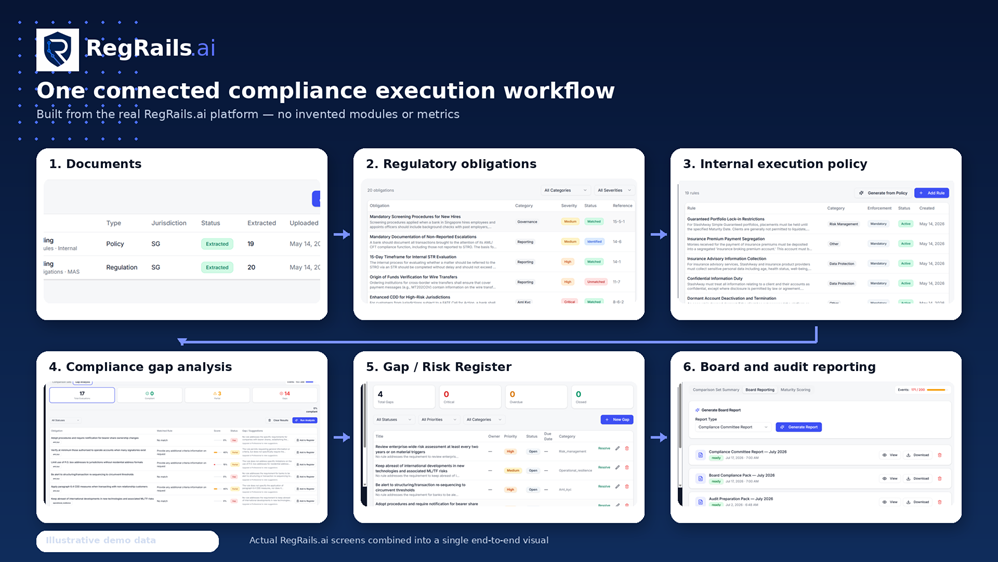
One connected workflow from regulatory change to clear action
Most compliance tools start with an empty box and ask you to find the right regulations yourself. RegRails.ai starts with the obligations for your licence already in place, then connects the steps that are usually scattered across documents, spreadsheets, emails and manually prepared reports - so compliance work produces structured requirements, identified gaps, owned remediation and management-ready insight.
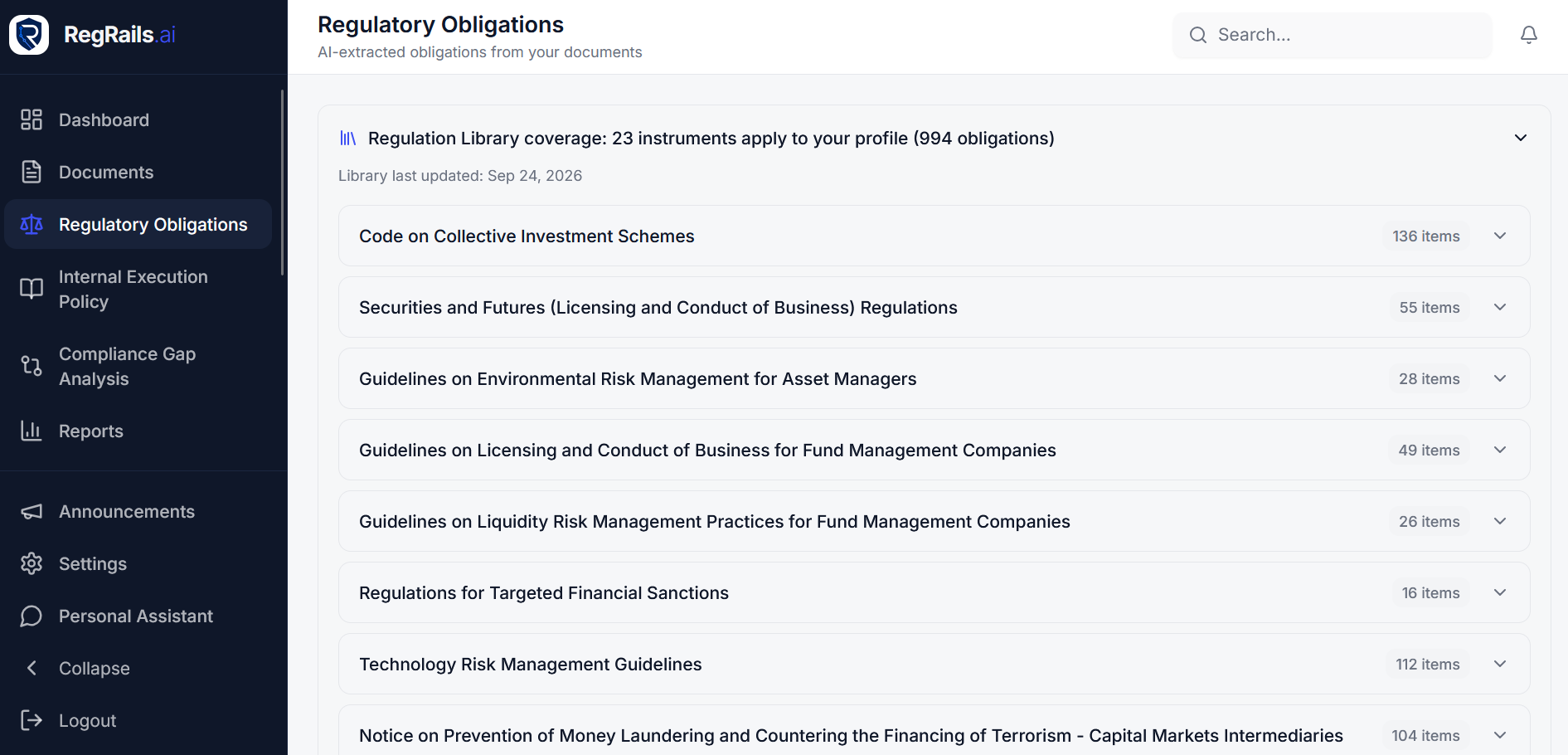
Your obligations, already loaded
Finding the right notices, guidelines and circulars - and confirming you have the current version - is the hardest part of the job. RegRails.ai maintains them for you. Set your jurisdiction, regulator, licence type and regulated activities, and the obligations that apply to your firm are there on the first screen, each tagged at the level it actually applies. For Singapore, the library is complete for capital markets services licensees doing fund management, including retail.
- 23 MAS instruments maintained for CMS fund management, including retail
- Obligations tagged regulator-wide, licence-wide or to a specific regulated activity
- Source reference, section, version and effective date on every obligation
- A coverage statement showing which instruments are included and when the library was last updated
- Add your own supplementary obligations - group policies, licence conditions, contractual terms
A maintained regulatory obligations library for MAS-licensed fund managers - so compliance review starts with the right requirements, not a blank spreadsheet.
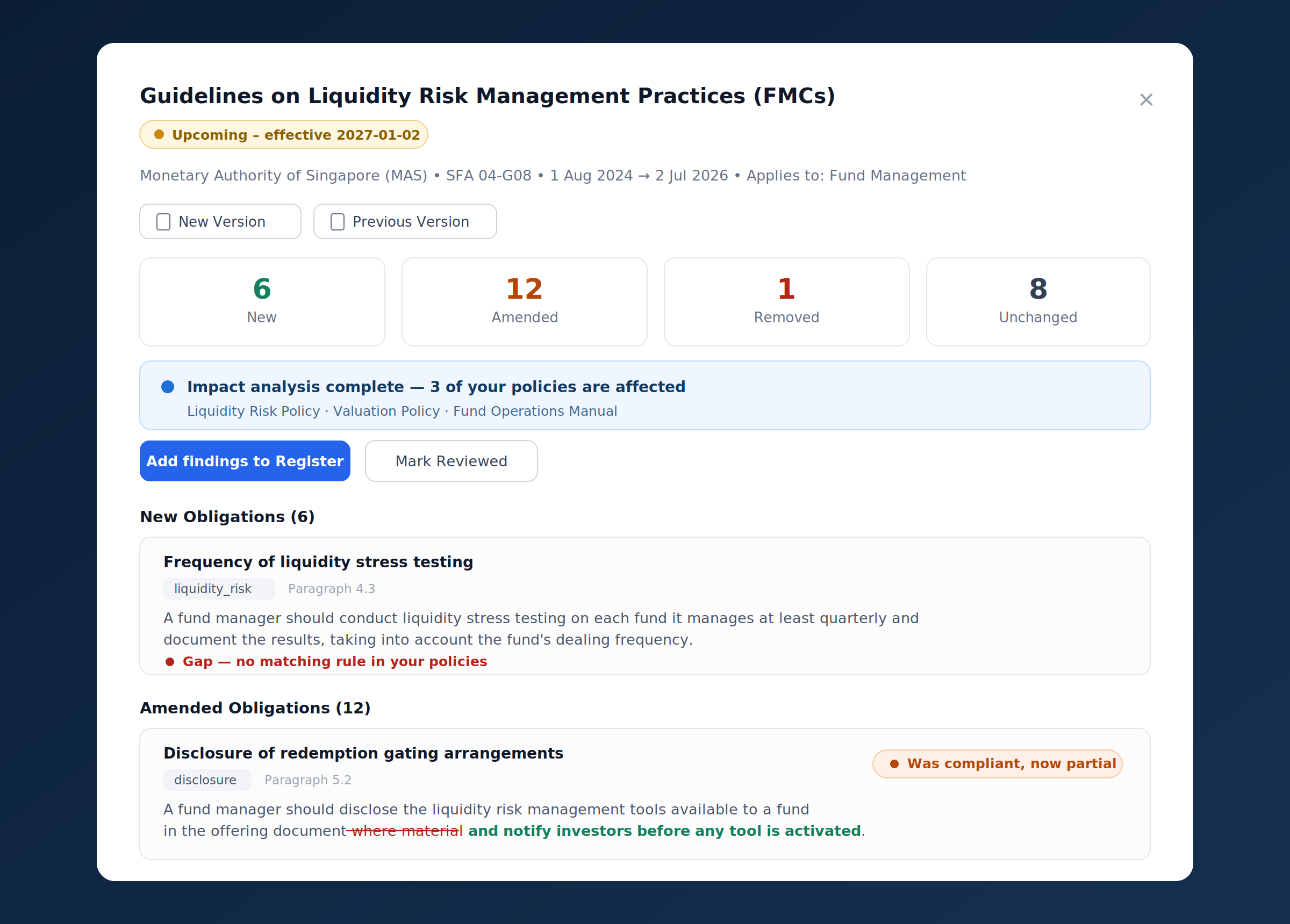
Know which policies break when the rules change
Loading regulations once is not enough, because regulators amend them. When a new version of an instrument is issued, RegRails.ai compares it against the previous one and labels every obligation as new, amended, unchanged or removed. It then re-checks only what changed against your policies and shows which of your documents no longer cover the requirement.
- Version-by-version comparison with old and new obligation text side by side
- Only changed obligations are re-analysed, so settled work is not disturbed
- Future-dated changes shown as upcoming requirements, separate from your current score
- Notification of what changed, when it takes effect and how many of your policies are affected
- Every instrument version retained, with superseded versions kept in history
- Earlier reports never overwritten - each keeps the versions it was run against
Regulatory change management for smaller compliance teams - see the impact of an amended notice on your own policies, not just that it happened.
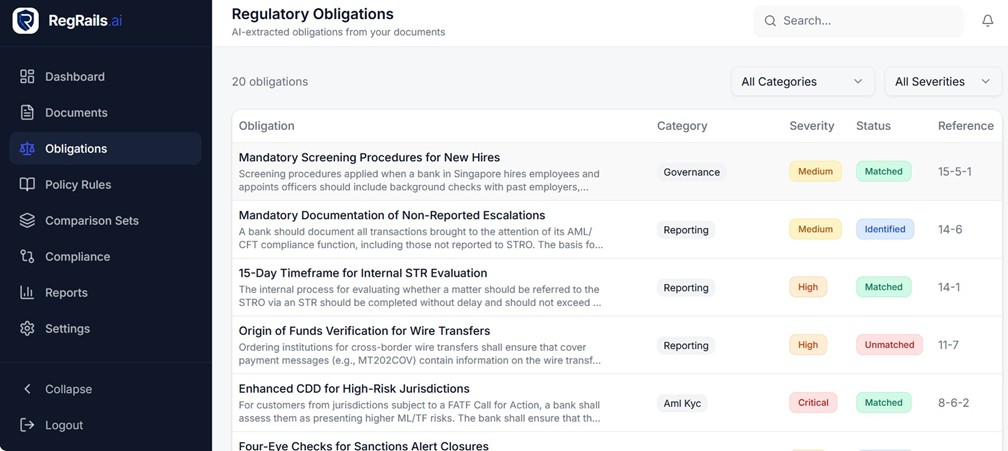
Obligation extraction and internal execution policy
The same extraction that builds the maintained library works on anything else you upload. Turn dense regulatory and policy documents into structured requirements your team can review, search and use, each retaining useful context such as category, severity, status and source reference.
- AI-assisted regulatory obligation extraction
- Category and severity classification
- Source references for traceability
- Internal execution policy rule extraction from your own documents
- Search and filter functions for faster review
- Human review before conclusions are relied upon
Compliance gap analysis
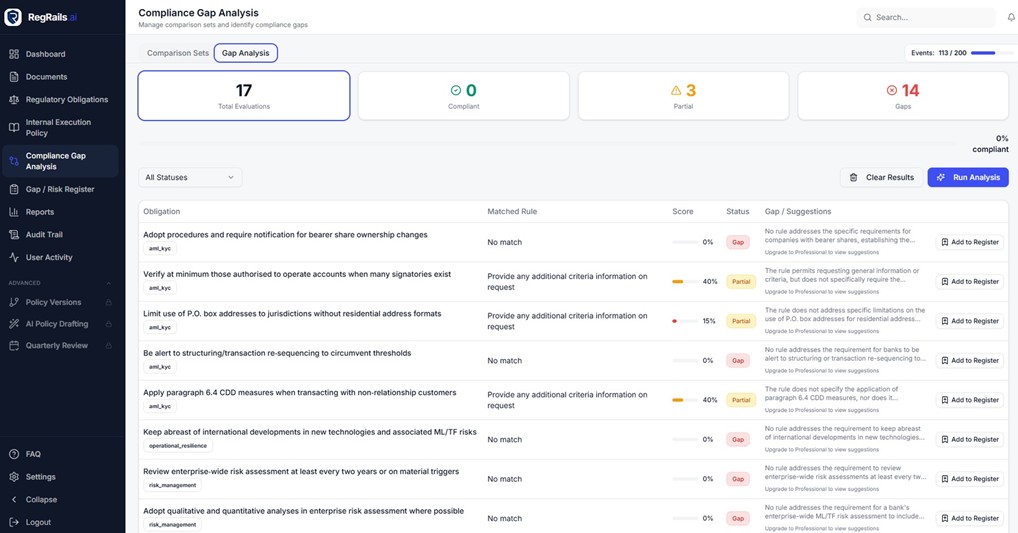
Know which obligations are covered, where policy language is incomplete and which requirements have no matching internal rule. Your applicable obligations come from the maintained library for your licence, so the analysis runs against the real requirements rather than whatever happened to be uploaded - distinguishing compliant, partial and gap outcomes.
- Targeted comparison sets
- Compliant, partial and gap classifications
- Matched-rule visibility with the obligation section reference behind every result
- Six-dimension coverage scores, with the instrument versions recorded on every run
- Gap suggestions and recommendations
- Direct Add to Register workflow
Use RegRails.ai as policy gap analysis software to compare internal execution policies against the obligations that actually apply to your licence, and identify gaps before an audit or incident forces the issue.
Turn findings into owned remediation
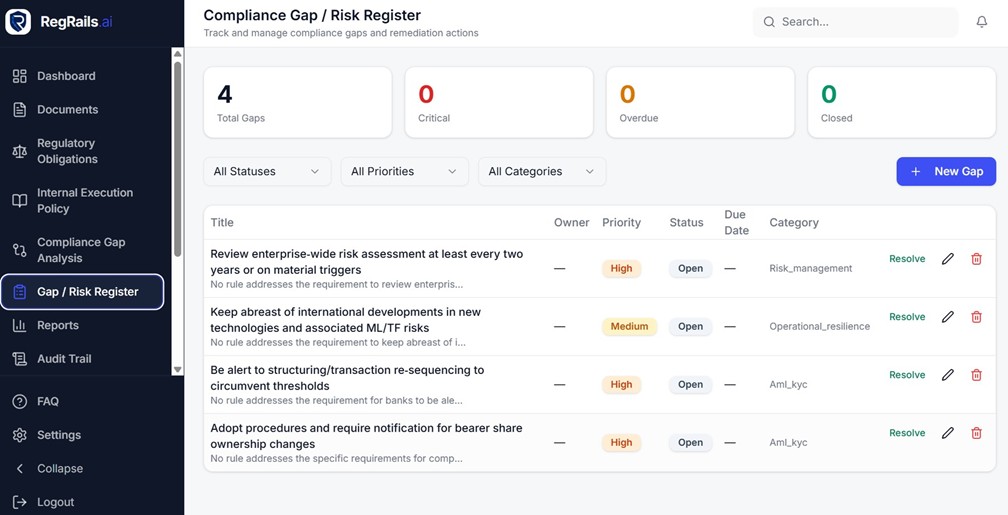
A gap is only useful when someone owns the next action. RegRails.ai moves identified findings into a structured Gap / Risk Register so teams can prioritise, assign, monitor and resolve remediation, with category, priority, status, ownership and due-date fields.
- Add findings from gap analysis to the register
- Set priority and status
- Assign an owner and due date
- Filter by status, priority and category
- Resolve, edit or remove findings
- Maintain a clearer remediation trail
Replace disconnected remediation spreadsheets with a compliance risk register linked directly to the obligations and policy gaps that created the action.
See the state of compliance execution
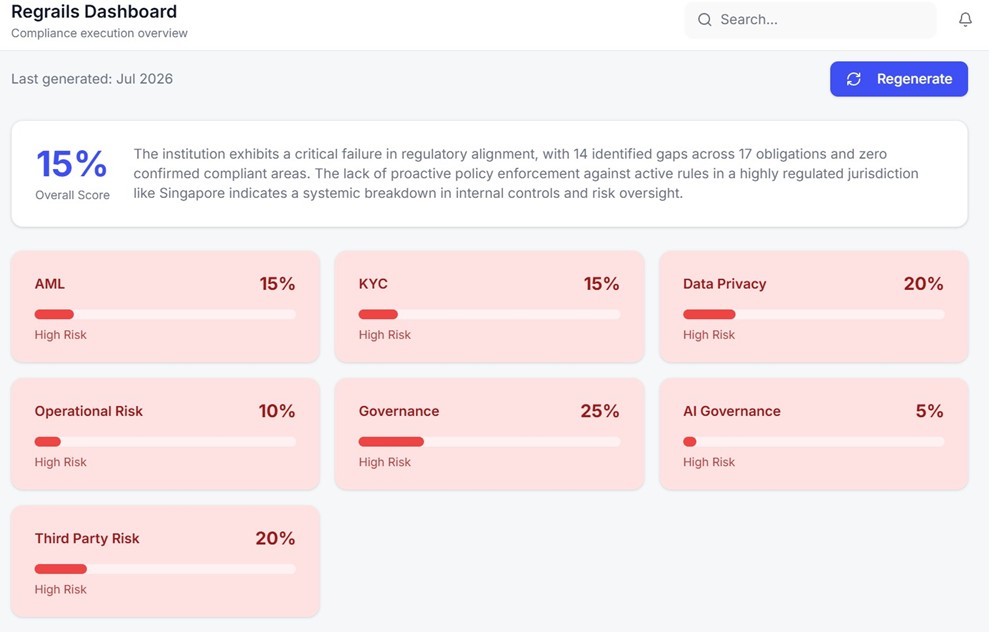
Give compliance leaders a consolidated view of work in progress, the gaps requiring attention and where exposure is concentrated. The dashboard brings together documents, obligations, internal execution policy, compliance score, obligations by category, recent activity and regulatory announcements, with a risk heatmap view for exposure.
- Compliance execution overview
- Regulatory announcements and upcoming requirements
- Compliance score and status
- Obligations by category
- Recent platform activity
- Risk heatmap view and domain-level indicators
Turn compliance work into management-ready reporting
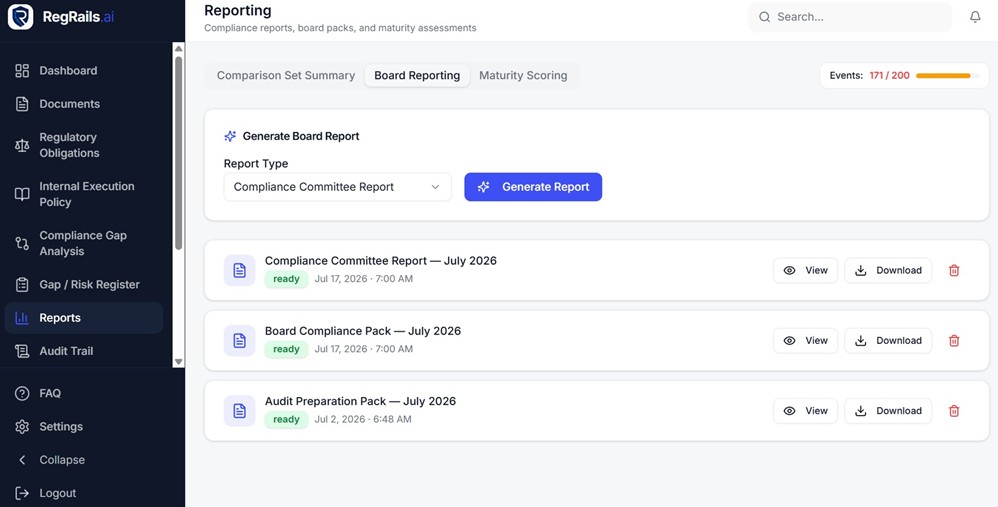
Move from working-level analysis to structured reports for senior management, boards, compliance committees and audit preparation. Current report types include Compliance Committee Report, Board Compliance Pack and Audit Preparation Pack, viewable and downloadable from the reporting workspace.
- Compliance summary reports
- Compliance Committee Reports
- Board Compliance Packs
- Audit Preparation Packs
- View and download generated reports
- A retained record of previously generated outputs
Generate board compliance reporting and audit-ready compliance reports from the same workflow used to extract obligations, analyse policy gaps and track remediation.
Measure maturity, not just document coverage
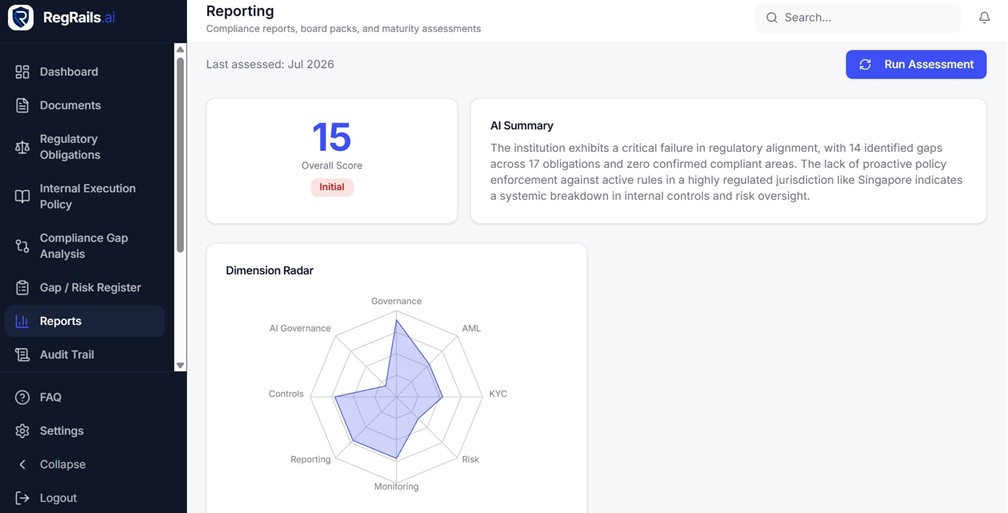
Understand how the institution performs across key compliance, risk and governance dimensions, then focus improvement where it matters most. The maturity assessment includes an overall score and stage, an AI-generated summary, a dimension radar, individual dimension scores and prioritised improvement recommendations.
- Overall maturity score and stage
- AI-generated assessment summary
- Dimension radar
- Dimension-by-dimension scoring
- Prioritised improvement recommendations
- Reassessment to review progress over time
Use RegRails.ai for compliance maturity assessment, AI governance readiness and third-party risk readiness without separating the assessment from the underlying obligations, policies and gaps.
Maintain a traceable compliance workflow
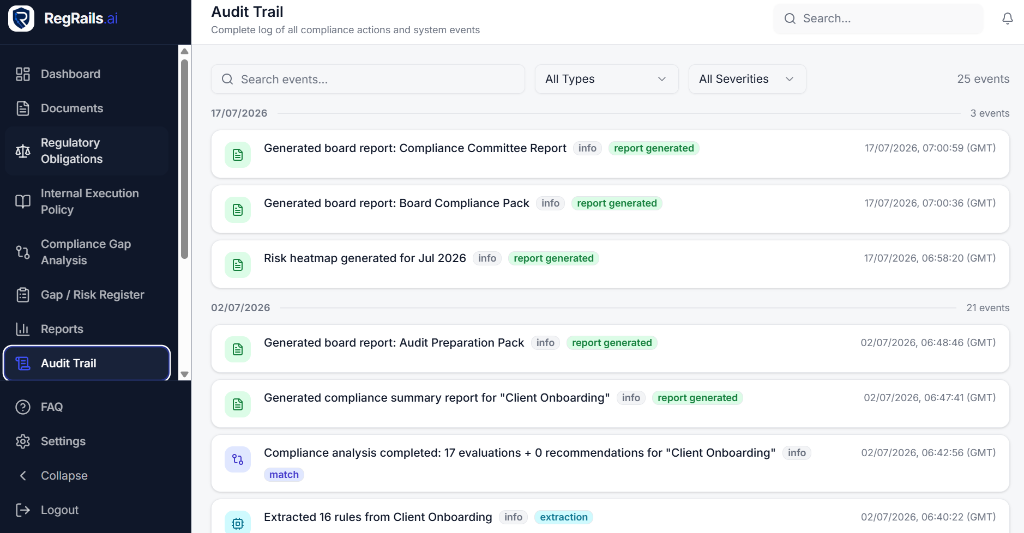
Keep a clear line from the source instrument and its version, through the extracted obligation, to your policy rules, findings, remediation actions, assessments and reports. Audit Trail and User Activity records support traceability and oversight across the workflow, and every gap analysis records the library versions it ran against so a past report can be reproduced exactly.
- Trace the workflow from source instrument and version through to reports
- Review audit trail and user activity records
- Retain generated reports, assessment history and superseded instrument versions
- Support repeat reviews through Quarterly Review
Built around the compliance work teams already do
RegRails.ai connects the steps that are often scattered across documents, spreadsheets, emails and manually prepared reports - starting from obligations that are already maintained for your licence, so the same work produces structured requirements, identified gaps, owned remediation and management-ready reporting.
Designed for regulated financial firms
RegRails.ai is designed for firms that face serious compliance expectations but do not want the cost and implementation burden of a heavy enterprise platform. The maintained library is live today for MAS-licensed fund managers; firms in other jurisdictions upload their own obligations and use every other part of the platform the same way.
Human judgement stays in control
RegRails.ai uses AI to assist with extraction, mapping, analysis, recommendations and report generation. Every obligation in the maintained library is reviewed and approved before it goes live, and compliance professionals remain responsible for reviewing outputs, applying judgement, confirming applicability and approving final conclusions.
Ask the Personal Assistant
Question your own compliance data in plain English — obligations, gaps, remediation status and reports — and get direct answers grounded in your records. Like every AI-assisted output on RegRails.ai, answers are a starting point for review, not a substitute for professional judgement.